You do not need to solve every question in order. You do need to reach the questions you can answer. A difficult problem is a decision about where to spend the next few minutes, not a requirement to finish it before moving on.
Exam rules checked September 12, 2026: NCEES Examinee Guide, pages 11–12 and 16, and NCEES scoring policy. The practice methods and examples below are our recommendations.
The Time Budget, Exactly
Both exams give you a fixed pool of time for a fixed number of questions. Divide them and you get the number that should be in your head every practice session:
| Exam | Questions | Exam time | Budget per question |
|---|---|---|---|
| FE (all disciplines) | 110 | 5 h 20 min | 2 min 54.5 sec |
| PE (most CBT exams) | 80 | 8 h | 6 min 0 sec |
320 ÷ 110 = 2.909 minutes. That is an average, not a deadline on each problem: a direct conversion might take one minute and leave room for a longer calculation. Calculator fluency and handbook-search practice reduce time spent executing a method you already understand. PE timing varies by exam; use your discipline’s specification rather than applying the FE budget.
A checkpoint you can calculate
Suppose you have reached 20 FE questions and used 70 minutes. An even allocation for those questions is 20 × 320 ÷ 110 = 58 minutes 11 seconds, so you have spent about 12 minutes more. This is a cue to shorten unproductive attempts and see the remaining questions, not to rush every answer. Count questions you have reached, including flagged ones, and account for the review time those flags still need.
Before starting, choose a section-one budget using its actual question count. With 55 questions, an even split is 160 minutes, leaving 160 for section two. The sections are not separately timed; spending longer on the first leaves less for the second.
Read Accuracy and Pace Together
A correct ten-minute solution proves something different from a correct three-minute solution. Keep the accuracy, then identify where the time went: choosing the equation, finding the reference, entering the calculation or checking the result. If you understand the concept but repeatedly run over budget, practice that slow step on fresh problems instead of rereading the whole chapter.
The reverse failure exists too: rushing questions you find easy and donating points to careless errors. If a topic sits well under budget with misses, the fix is discipline, not speed.
The Flag-and-Return Discipline
Flagging preserves a chance to return while you work through the current section. It does not preserve access after you submit that section. The scheduled break follows section-one submission; you cannot use section-two time to reopen section one.
- Choose a path. Can you name the unknown, a usable relationship and the inputs? If so, start. If you are searching without a plan, defer earlier.
- Check for progress. At roughly one average question budget, ask whether the next step is clear. Continuing can be sensible when one calculation remains; repeating the same failed search is a reason to stop. The app’s later over-budget nudge is a reminder, not a requirement to wait.
- Answer, flag, move. Eliminate options when you can and enter your best response. Wrong answers have no deduction. This also applies to alternative item types, although guessing strategies differ from four-option multiple choice.
- Return before submission. Review blanks and flags while preserving time for the remaining section. Prefer a flag with a clear next step over one that still needs a method.
Three Problems, Three Pacing Decisions
These original examples teach decisions, not a fixed quota of questions to skip. A problem that is quick for one engineer may be a sensible flag for another.
1. Solve now: a direct unit conversion
Problem: Water flows at 18 liters per minute. What is the flow in cubic meters per second?
Cue: One conversion chain, no new equation. Write 18 L/min × (1 m³/1,000 L) × (1 min/60 s) = 0.000300 m³/s.
Check: Liters and minutes cancel. Converting minutes to seconds reduces the numerical rate. Take the moment to check the requested unit, then move on.
2. Defer: the same search is going nowhere
Problem: A payment of $5,000 is due in three years. Find its present value at 6% annual compound interest. Choices: $4,198; $4,450; $5,000; $5,955.
Decision: You have spent two minutes looking for an annuity factor. A single future payment is not an annuity. If you still cannot identify the factor, eliminate values at or above $5,000, enter your best remaining choice and flag it.
Reveal the method and answer
Use the single-payment present-worth relationship: P = F/(1 + i)n = 5,000/1.063 = $4,198.10, so choose $4,198. For the next practice session, locate this relationship under engineering economics in the FE Handbook and contrast it with a uniform series.
3. Revisit: the setup is already complete
Problem: Find the positive root of x² + 5x − 14 = 0. You flagged it after entering the constant as +14 and getting an unexpected result.
Why return: The equation and a specific suspected error are already identified. Check the sign before starting another long reference search. Factoring gives (x + 7)(x − 2) = 0, so the positive root is x = 2. Substitute: 4 + 10 − 14 = 0. The calculator guide explains when a polynomial solver helps; this one is also quick by hand.
Try the decision: five minutes left in this section
You have one unanswered unit-conversion question, one flagged answer with a suspected sign error, and one flagged problem whose method you still do not recognize. What order would you choose?
A defensible order: Answer the blank conversion, check the specific sign error, then use remaining time on the unknown-method problem. Confirm every item has a response before submission. The aim is to protect likely correct answers while keeping a chance at the hard one.
How to Train Pacing (Even 10 Minutes at a Time)
You do not need a free Saturday to train exam rhythm. In our app’s timed practice, you tell it how long you have — ten minutes between classes, an hour after work — and it builds a session sized to the real budget: at FE pace, a 10-minute session is 3 questions and an hour is 20. While you work, a live pace meter shows whether you are ahead of or behind the rhythm, a gentle nudge fires if one question runs past twice its budget, and the results screen gives a pace verdict alongside your score. Life happens mid-session, so the timer pauses — something the real exam will not do for you, which is exactly why the rest of the session should feel like the real thing.
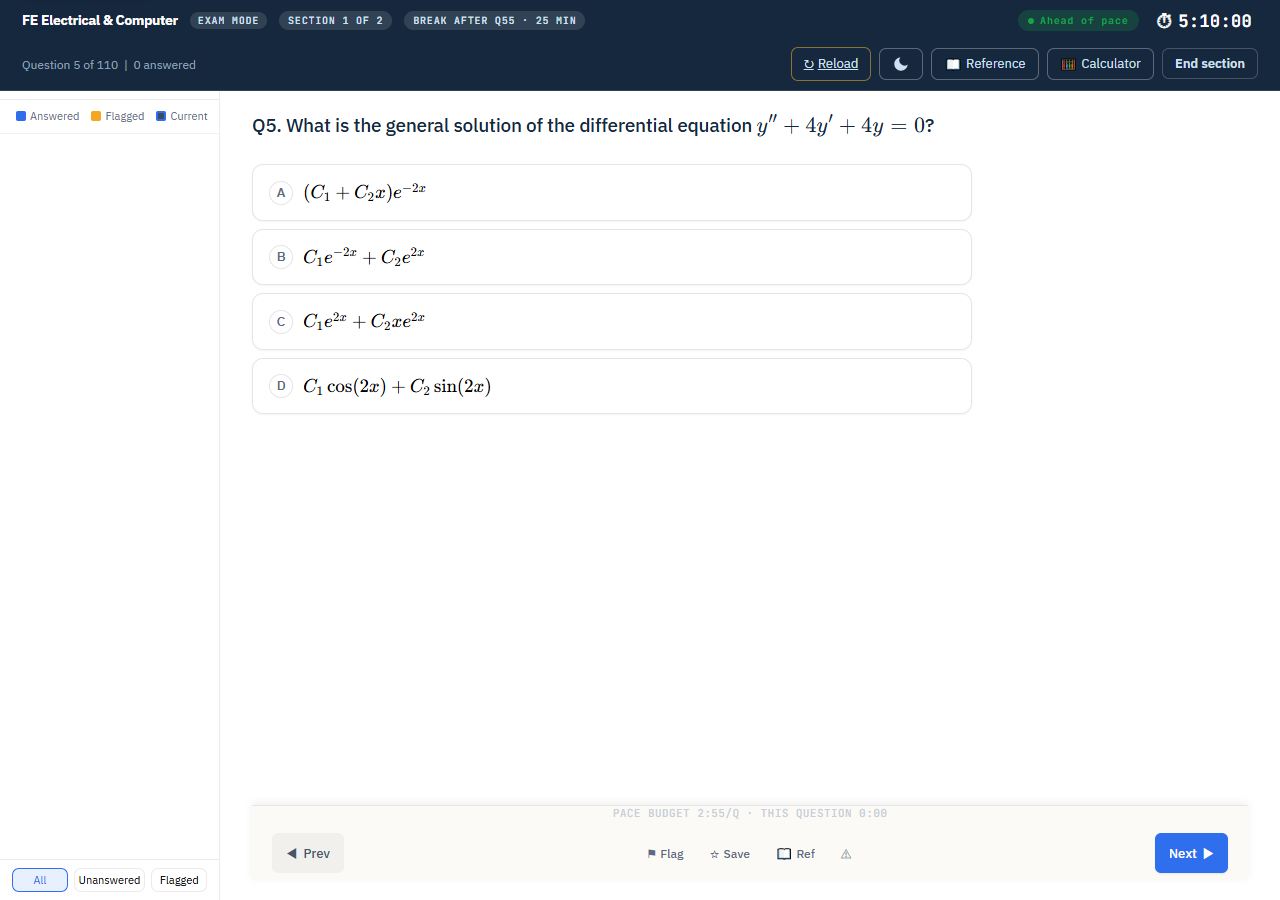
Try three fresh questions, then review them outside the timed block. Record the answer, elapsed time and cause of any delay. Next session, drill the cause: a calculator sequence, a reference keyword, or the underlying concept. Keep untimed learning sessions alongside timed practice; the 8- and 12-week schedules show how to budget both.
Not Sure Where You Stand? Take the Placement Diagnostic
The licensed app’s placement diagnostic gives you 24 questions allocated using the exam blueprint, on the exam clock, with feedback at the end. At FE pace that is about 70 minutes. Results seed the planner and weak-area panels, but a small sample is a starting map, not a readiness verdict or an official NCEES diagnostic. For a shorter start, try the free 20-question practice set. If you have been away from school, use the returning-engineer first-week plan.
Per-Topic Pacing Reality
Use question structure and your own fresh-attempt history to estimate effort. These are practice categories, not timing rules for entire topics:
- Direct: a recognized definition, conversion or single substitution. Check units and the requested quantity.
- Several known steps: a circuit reduction, fluid calculation or economics relationship. Decide whether the setup is clear before committing time.
- Uncertain path: repeated searches, an unfamiliar setup or a failed calculation you cannot diagnose. Consider deferring; a solver button does not choose the governing equation for you.
Banking time on the fast topics is what pays for the slow ones. That only happens if you recognize the fast ones instantly — which is a repetition skill, built in volume practice.
Frequently Asked Questions
How many minutes per question do you get on the FE exam?
About 2 minutes 55 seconds: 320 minutes divided by 110 questions is 2 minutes 54.5 seconds. This includes reading, reference lookup, calculation and review.
What if I run out of time on the FE exam?
Unanswered questions score zero, and there is no penalty for guessing — never leave blanks. If you are consistently short on time in practice, the fix is usually flag discipline and calculator/handbook speed, not reading faster.
Should I practice with a timer from day one?
No. Early practice should be untimed and thorough — read every explanation, chase every why-wrong. Bring the clock in progressively and make the final few weeks mostly timed, so exam pace is trained without sacrificing learning depth.
Is it bad to finish a section early?
Finishing early does not prove that you rushed. Use available review time on blanks, flags, requested units and specific suspected mistakes. Balance that review against the time you need for the remaining section; you cannot reopen a section after submitting it.
Train the rhythm before it counts. Try a free 20-question set on the real exam clock — live pace meter included.
Start Free Timed Practice