Put real study blocks on your calendar, then assign work that fits, including time to understand missed questions. These templates organize review, practice and simulation; the study-hour model helps adjust them to your pace.
Choose Your Plan
- 8-Week Plan (about 14 hr/week): About 110 hours, including review: the budget for a recent graduate, at the median weekly load passers report.
- 12-Week Plan (10–12 hr/week): About 120–145 hours, including review: a recent graduate at 10 hours per week, or about 5 years out at 12.
- Extended plan: 8 or more years out, budget about 170–185 hours; at 8 hours per week that is 20+ weeks. Stretch the relearning weeks rather than dropping review.
- Both plans follow the same structure: diagnose → relearn by exam weight × weakness → mixed timed sets → Hard sets and a final simulation → 3-day taper
Use fresh questions to identify gaps, then measure how long solving and reviewing them takes. If you are returning after years away, try the six-hour first-week plan before estimating the rest.
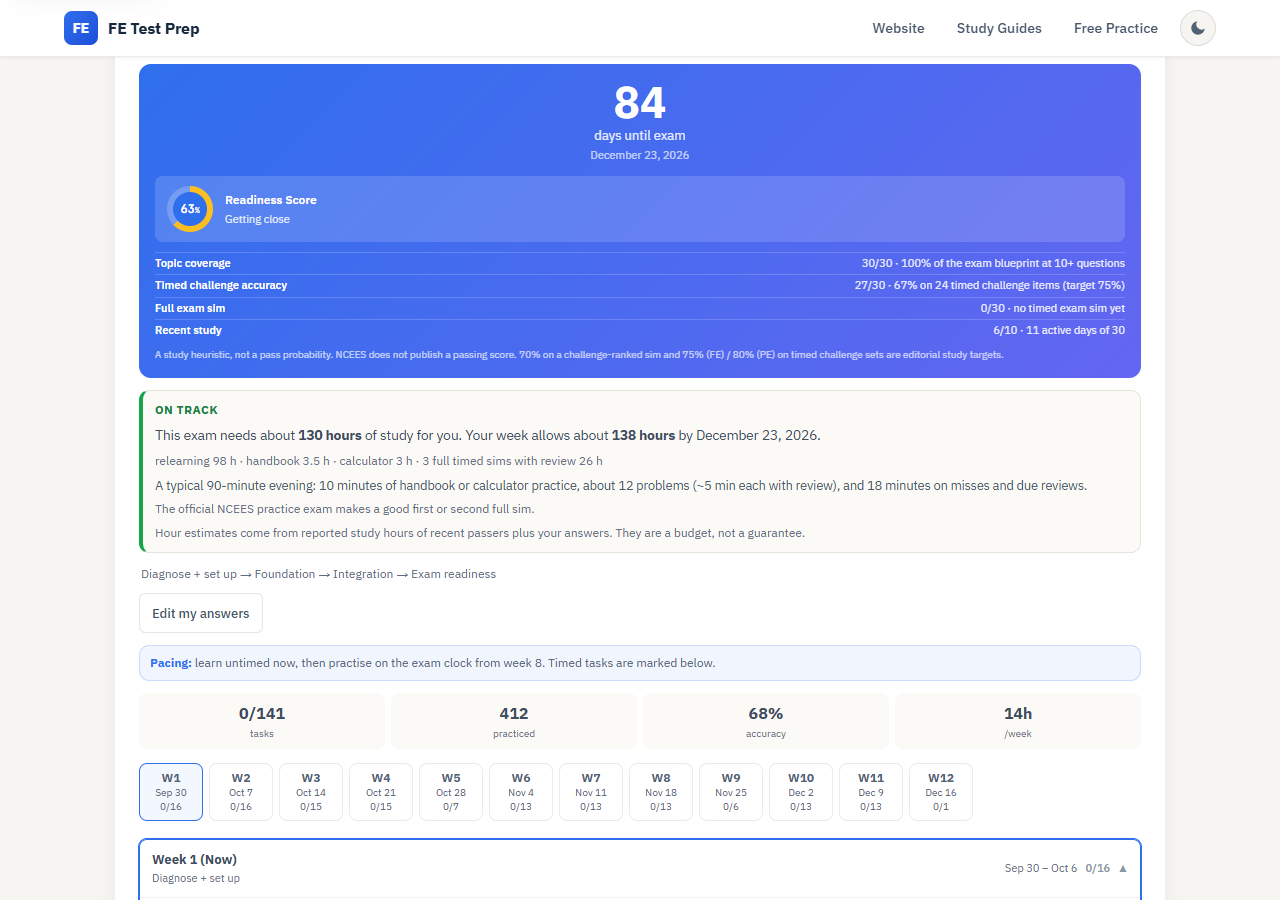
Skip the Spreadsheet — Get a Personalized Study Plan
Our Study Planner turns the budget on this page into your own numbers. Answer a short questionnaire and it compares the work your exam needs with the time your calendar actually has.
- Asks for your exam date, weeknight and weekend study time, years since the coursework, first attempt or retake, handbook and calculator familiarity, and your goal
- Shows the hours you need next to the hours your calendar allows
- If they do not fit, shows what to change
Before You Start: Take a Diagnostic Exam
Before week 1, sample fresh questions with your calculator and supplied handbook. The licensed app offers a 24-question timed placement diagnostic with feedback at the end, about 70 minutes at FE pace. Its results are provisional. The free 20-question set is a separate public sample; neither replaces a full simulation or establishes a passing score.
Use each topic result to choose a starting task. On a small sample, one question can move the percentage substantially, so confirm the pattern with more fresh attempts:
- Consistently correct without help: Keep short refresh sessions and verify with mixed questions.
- Mixed results or slow execution: Identify the recurring error and practice that step.
- Repeated setup failures: Repair the concept or prerequisite before adding difficulty.
The 8-Week Study Plan (about 14 hours/week)
This plan is designed for recent graduates within about a year of school, whose budget is about 110 hours: eight weeks at about 14 hours per week, the median weekly load passers report. Two years out, the budget is about 125 hours, or about 16 hours per week over eight weeks. Total study time: approximately 110–125 hours.
| Week | Focus | Activities |
|---|---|---|
| Week 1 | Diagnose and set up your tools | Take a placement diagnostic in the first two or three days and log each miss by cause. Start 10-minute handbook and calculator warm-ups at the top of each session: handbook fluency takes 2–6 hours in all, the calculator 2–3 (about 6 if you are new to the TI-36X Pro). Then begin the topic with the highest exam weight × weakness; for many candidates that is Mathematics. |
| Weeks 2–3 | Relearn high-weight weak topics | Blocked, untimed topic work in exam weight × weakness order. Civil water/environmental, structural and geotechnical topics have higher published ranges than statics or fluids; Electrical math and circuit analysis have higher ranges than signals. Repair prerequisites first when needed. A 90-minute session holds about 12 problems plus review; hold about 20% of each topic’s time for 2–3 spaced revisits. |
| Week 4 | First full simulation + next topics | Early in the week, take a full 110-question timed simulation (about 40% of the way through) and review it; the pair takes about 8.5 hours. Then relearn the next weighted topics, starting with what the simulation exposed. Ethics and Economics are among the most compact sections — bank reliable review gains there. |
| Week 5 | Finish relearning, start mixing | Finish the remaining topics by mid-week (about 55% of the runway), then start mixed timed sets. Aim to have worked every exam topic at least once by the end of this week. |
| Week 6 | Mixed timed sets + spaced review | Mixed sets at exam pace, about 2 minutes 55 seconds per question. About a quarter of your attempts should be re-attempts of earlier misses. If you plan three simulations, take the second here; the official NCEES practice exam works well. |
| Week 7 | Hard sets + final simulation | Hard and challenge sets on your weakest high-weight topics. Take the final full simulation at the end of the week, about 7 days before the exam, and review it. |
| Week 8 | Repair and taper | Repair what the final simulation exposed early in the week. The last 3 days are a taper: light review only — no new material. Review the exam day checklist. Rest the day before your exam. |
Open the Study Planner
The 12-Week Study Plan (10–12 hours/week)
This plan fits a recent graduate at 10 hours per week (about 120 hours) or someone about 5 years out at 12 hours per week (about 145 hours). Working full-time, 8–12 hours per week is typical. If you are 8 or more years out (about 170–185 hours), keep the same phases and stretch the relearning weeks: at 8 hours per week they take 20+ weeks. Total study time: approximately 120–145 hours.
| Week | Focus | Activities |
|---|---|---|
| Week 1 | Diagnose and set up your tools | Take a placement diagnostic in the first two or three days and log each miss by cause. Start 10-minute handbook and calculator warm-ups at the top of each session (handbook 2–6 hours in all; calculator 2–3, about 6 if you are new to the TI-36X Pro). Begin the topic with the highest exam weight × weakness. |
| Weeks 2–4 | Relearn high-weight weak topics | If the diagnostic shows calculus, differential equations or linear algebra blocking other topics, rebuild them first. Then work blocked, untimed topics in exam weight × weakness order: combine the official topic ranges with your fresh results, because there is no single top-three list for every FE discipline. About 12 problems per 90-minute session; hold about 20% of each topic’s time for 2–3 spaced revisits. |
| Week 5 | First full simulation | Take a full 110-question timed simulation about 40% of the way through, score it by section and review it (about 8.5 hours with review). Use it to re-rank the remaining topics, then keep relearning. |
| Weeks 6–7 | Remaining topics | Relearn the medium- and lower-weight topics, including Probability and Statistics, Ethics and Economics. Ethics needs interpretation of professional obligations, not just formula recall. Keep revisiting earlier topics to prevent forgetting. By the end of week 7 (a little past halfway), every topic should have a meaningful sample. |
| Weeks 8–10 | Mixed timed sets + spaced review | Mixed sets at exam pace. About a quarter of your attempts should be re-attempts of earlier misses, spaced further apart early and closer together near the exam. Take a second full simulation in week 9; the official NCEES practice exam works well, since it is about as hard as the real FE. |
| Week 11 | Hard sets + final simulation | Hard and challenge sets on your weakest high-weight topics. Take the final full simulation at the end of the week, about 7 days before the exam, and compare it with week 5 and week 9. |
| Week 12 | Repair and taper | Repair the final simulation’s misses early in the week. The last 3 days are light review, no new material. Review the exam day checklist. Check your calculator batteries. Get good sleep the night before. |
Open the Study Planner
Weekly Study Structure
This sample allocates ten hours, including review, which is typical for someone working full-time (8–12 hours per week). Change the block lengths to fit your workweek; keep solving, learning from errors and revisiting earlier material in the plan.
Sample Weekly Breakdown (10 hours)
- Monday (90 min): 10-minute handbook or calculator warm-up, about 12 problems on the current topic, then about 18 minutes reviewing misses and due spaced items
- Tuesday (90 min): The same pattern on the same topic. Read the explanation for every miss.
- Wednesday (90 min): The same pattern, plus one spaced revisit of an earlier topic
- Thursday (90 min): The same pattern. Once you reach the mixed phase, make this a mixed set at exam pace.
- Friday: Rest day
- Saturday (2.5 hr): A timed mixed set followed by review. At FE pace, 30 questions use about 88 minutes, leaving roughly an hour for review. In a simulation week, give Saturday to the full simulation and spread its review across the weeknights.
- Sunday (1.5 hr): Re-attempt earlier misses and plan next week. Total: 4 × 1.5 + 2.5 + 1.5 = 10 hours.
Study Techniques That Actually Work
Spaced repetition
Revisit each topic 2–3 times after you first learn it, spacing the revisits at about 15% of the days left before your exam: roughly every two weeks early in a 12-week plan, tightening to every few days near the end. Research finds that expanding and even gaps work about equally well, so doing the revisit matters more than the exact interval. Make about a quarter of your problem attempts re-attempts of earlier misses. Pair that review with short calculator drills so you are not just recognizing formulas, but also practicing the exact keystrokes that make timed exam work faster.
Active recall
Test yourself instead of rereading. Close your notes and try to solve a problem from memory. If you cannot, that tells you what to review. Rereading feels productive but creates a false sense of familiarity. Struggling to recall information is what builds durable memory. That is exactly what practice mode does — every question forces active recall with immediate feedback.
Practice under exam conditions
Two or three times during your study plan — the first about 40% of the way through, the last about 7 days before the exam — sit down with your approved calculator, set a timer, and work through a full 110-question practice exam without stopping. Each one takes the 5 hours 20 minutes of exam time plus roughly 3 hours of review. This builds stamina and teaches you pacing. Make the official NCEES practice exam one of them; for the FE it is about as hard as the real exam. The app’s Exam Mode replicates the real NCEES testing experience with the same time limits, question count, and section breaks.
Practice on the exam clock, even in short sessions
The FE gives you 320 minutes for 110 questions, about 2 minutes 55 seconds per question. In the app’s timed practice, choose the time available and work a session sized to exam pace. Review timing alongside accuracy and identify delays in setup, handbook search or calculation. Keep untimed learning alongside these checks. The pacing guide includes worked examples and a flag-and-return exercise.
The review habit
Every time you miss a practice problem, do not just read the explanation and move on. Understand why the wrong answers are wrong. Was it a concept gap? A calculation error? A misread question? Each question in our app includes detailed explanations, step-by-step TI-36X Pro calculator keystrokes, and “why wrong” distractor analysis that breaks down the specific mistake each incorrect option represents.
How to Adjust Your Schedule
Compare planned work with what you completed, including review. Change the task mix before assuming that a busier calendar will solve the problem:
- Falling behind? Check for unrealistic question counts, long review cycles or missing prerequisites. Reduce repeat work on topics with consistent fresh-attempt evidence.
- Ahead of schedule? Check untested topics and use a mixed set or simulation to answer a remaining coverage or stamina question.
- Life happens? Move unfinished work to realistic slots. Before rescheduling an exam, check current NCEES/Pearson deadlines, fees and appointment availability.
- Practice scores look strong? Check that questions are fresh, coverage is broad and timing is realistic. A practice percentage is not an official passing cutoff.
What to Do the Week Before the Exam
- Monday–Tuesday: Review your final simulation (taken about 7 days out) and repair its weak spots.
- Wednesday–Thursday: Taper: no new material. Review your error log. Skim through the FE Reference Handbook one last time to reinforce where key formulas are located.
- Friday: No studying. Prepare your exam day materials using the exam day checklist. Replace your calculator battery. Print your confirmation.
- Saturday (if exam is Monday): Light activity, early bedtime. Do something relaxing. You have already done the work.
Frequently Asked Questions
What is the best study schedule for the FE exam?
Work backwards from your exam date. Diagnose and set up your handbook and calculator; relearn topics in order of exam weight and your weakness for roughly the first 55% of the runway, with the first full simulation about 40% of the way in; move to mixed timed sets with spaced review; finish with Hard and challenge sets and a final full simulation about 7 days before the exam; then taper for 3 days with no new material. A recent graduate budgets about 110 hours: 8 weeks at about 14 hours per week, or 12 weeks at about 10.
How many hours per week should I study for the FE exam?
Passers report a median of about 14 hours per week (middle half 11–20); working full-time, 8–12 hours is typical. Divide your total budget by the hours you can sustain: about 110 hours within a year of school is about 12 weeks at 10 hours per week, while 8 or more years out (about 170–185 hours) is 20+ weeks at 8 hours per week. Reserve a separate long block for each full simulation.
When should I start taking practice exams for the FE?
Take a placement diagnostic in the first few days, then your first full timed simulation about 40% of the way through the plan (week 4 of eight, week 5 of twelve) and the final one about 7 days before the exam. Plan 2–3 full simulations in all; each takes the 5 hours 20 minutes of exam time plus roughly 3 hours of review. Use the official NCEES practice exam as one of them; for the FE it is about as hard as the real exam.
How Many Hours Should You Study for the FE Exam?
Start from a budget, then divide by the hours you can protect. Hand-checked study-hour reports from 41 FE passers (2024–2026), plus NCEES pass-rate data, give the starting budgets below. They are budgets, not promises: hours predict passing only weakly, and NCEES publishes no passing percentage to convert them into. The budget covers new questions, explanations, concept repair, reference practice and full simulations.
| Time since the coursework | FE study budget |
|---|---|
| Within a year | About 110 hours (passers’ middle half: 60–200) |
| 2 years | About 125 hours |
| 5 years | About 145 hours |
| 8 years | About 170 hours |
| 12+ years | About 185 hours |
For a retake, add about 20–25% and spend at least half of the hours on the weakest areas of your NCEES diagnostic report. For an FE outside your degree field, add about 30% to the content time.
Time Since School Sets the Budget; Fresh Attempts Place It
Time away from the coursework is the biggest driver of the total: NCEES reports FE first-time pass rates of about 71% before graduation and about 63% for candidates 12+ months out, and passers further from school report more hours. Your first attempts decide where those hours go. A recent graduate may need substantial review in an unused subject; an experienced engineer may be fluent in one application and slow in another. Track whether each miss came from the concept, reference lookup, calculator, units or reading.
If you are returning after a long break, the ten-question skills check can help identify an initial task. It is a small skills sample, not a comprehensive diagnostic.
Calendar Capacity: What Your Available Hours Actually Buy
Compare each calendar with the budget above. The total includes review; it is not all solving time.
| Weekly availability | Calendar | Available hours | Planning consequence |
|---|---|---|---|
| 8 hr | 12 weeks | 96 | Short of a recent graduate’s ~110-hour budget; add two weeks or an hour a week. |
| 10 hr | 12 weeks | 120 | Fits a recent graduate (~110) or 2 years out (~125). |
| 14 hr | 8 weeks | 112 | The passers’ median weekly load; fits a recent graduate, with little room to absorb disrupted weeks. |
| 12 hr | 12 weeks | 144 | Fits about 5 years out (~145). |
| 8 hr | 22 weeks | 176 | Fits 8–12+ years out (~170–185); keep refresh sessions for topics studied early. |
If your budget is 170 hours and you can sustain 8 hours per week, that is about 21 study weeks before any buffer. Recalculate when your fresh results or your availability change.
Estimate Work in Measurable Blocks
Measure several of your own solve-and-review cycles before choosing question counts. The examples below expose their assumptions so you can substitute your pace.
| Study block | Assumption | Time calculation |
|---|---|---|
| Initial sample | A short set plus review | Reserve a session, record actual use, and expand sampling where topics have too few attempts. |
| Weak-topic practice | 25–40 of our problems at about 5 minutes each, including review | 125–200 minutes = about 2–3.3 hours per topic. Add lessons separately if they do not fit inside those cycles. |
| Timed mixed solving | 110–220 FE questions at the average exam budget | 320–640 minutes = 5 hours 20 minutes to 10 hours 40 minutes. Add explanation review separately. |
| Full simulation | 110 questions on the exam clock, plus review at about 60% of the exam time | 320 + 192 minutes = about 8.5 hours. Plan 2–3 in all. |
| Refresh session | 10 earlier-topic questions at about 5 minutes each, including review | About 50 minutes. Adjust using your observed time. |
| Tool skills | Handbook fluency 2–6 hours; calculator 2–3 hours (about 6 if you are new to the TI-36X Pro) | Spread as 10-minute warm-ups at the start of sessions. |
A worked weekly estimate
You plan four 90-minute weeknights. Each holds a 10-minute handbook or calculator warm-up, 12 problems at about five minutes each (60 minutes) and about 18 minutes reviewing misses and due spaced items: 4 × 90 = 360 minutes, or six hours. Add a 2.5-hour weekend timed set and 1.5 hours of re-attempts and planning and you have a ten-hour week holding about 48 problems plus the weekend set. If only eight hours are available, shorten the weekend set or drop a weeknight; do not remove review from the calculation.
Four weak topics at about 2–3.3 hours each would take about 8–13 hours of the practice described above. That is a component estimate: content relearning is about 70–80% of the whole budget, and the handbook, the calculator and 2–3 full simulations take the rest.
What Changes the Estimate?
- Prerequisites: missing algebra, units or a core concept can affect several topics. Repair the shared cause before adding more difficult questions.
- Coverage: strong results in a favorite topic do not answer what happens in untested topics. Use your discipline’s specification to find those gaps.
- Execution: correct but slow work may need calculator practice or handbook searches, rather than another lecture.
- Availability: use completed study hours, not an aspirational calendar. Include work trips, family commitments and the long simulation block.
Divide Time by the Current Bottleneck
Keep concept review, fresh practice, explanation review and timed work in the plan. Their proportions should change as your needs change. Across the whole plan, content relearning takes about 70–80% of the hours; handbook fluency (2–6 hours), the calculator (2–3 hours, about 6 if new to the TI-36X Pro) and 2–3 full simulations take the rest.
- Rebuilding: spend more time understanding a relationship, then apply it on easy fresh examples.
- Practicing: mix topics and revisit earlier repairs. Record assistance used so a correct answer is not mistaken for independent fluency.
- Simulating: use the exam clock and section rules, then review errors and timing in a separate session.
The specification determines which topics are tested. The supplied handbook supports solving; its entire contents are not a syllabus for every FE discipline.
Evidence That the Current Plan Needs Adjustment
- You still cannot set up fresh examples after reviewing the same prerequisite.
- Several specification topics have no meaningful practice sample.
- You finish familiar questions but leave fresh timed questions unread.
- Your actual availability repeatedly falls below the plan.
Change the task mix, weekly workload or calendar based on the cause. A low weekly-hour budget is a capacity constraint, not proof that you cannot retain material.
Evidence That More of the Same Is Not Helping
Repeatedly solving memorized items, rereading without testing recall, or polishing rare cases while ignoring recurring misses can add hours without answering whether you are improving. Switch to fresh representative questions and inspect the result.
There is no reliable conversion from an app percentage to an official passing score. NCEES uses scaled scoring and does not publish the passing score; see the official scoring explanation. The pass-rate guide describes populations, not your individual cutoff.
Build Your Personal Plan
- Choose your exam and read its applicable specification.
- Sample fresh problems and name the specific gaps.
- Measure your solve-and-review time, then estimate the next few work blocks.
- Divide the work by realistic weekly hours and reserve buffer.
- Check progress on new questions before expanding the estimate or choosing a final exam date.
For a busy workweek, see the eight-hour returning-engineer week. In the licensed app, the Study Planner asks for your exam date, weeknight and weekend time, years since the coursework, first attempt or retake, and handbook and calculator familiarity, then shows the hours you need next to the hours your calendar allows and what to change if they do not fit.
Make Each Study Block Produce Evidence
- Attempt the problem before opening the explanation.
- Write the cause of each miss and the next repair.
- Use the FE Handbook alongside practice and note search terms that actually work.
- Train the calculator operation you used, including a sign, mode and magnitude check.
- Practice solving, flagging and returning on mixed sets.
Study-Hour Questions
How many hours should I study for the FE exam?
About 110 hours if you are within a year of school, rising to about 125 at 2 years out, 145 at 5, 170 at 8 and 185 at 12 or more. Add about 20–25% for a retake and about 30% more content time for an FE outside your degree field. These budgets come from hand-checked reports from 41 FE passers (2024–2026) plus NCEES pass-rate data; they are not a guarantee, so keep measuring progress on fresh questions.
Can I study for the FE exam in two months?
Within a year of school, yes on paper: eight weeks at about 14 hours per week gives about 110 hours, the recent-graduate budget at the weekly load passers most often report. Five or more years out (about 145 hours and up), eight weeks means 18+ hours per week. Check progress on fresh timed questions before committing to the date.
How long should I study if I graduated years ago?
Budget about 145 hours at 5 years out, 170 at 8 and 185 at 12 or more. At 8 hours per week that is roughly 18–23 weeks. Use a first-week sample to decide which topics get most of those hours, and revisit earlier topics in a long plan.
Start Your Study Plan Today
Use these schedules to estimate your budget. In the licensed app, the Study Planner turns your answers into your own numbers:
- Answer a short questionnaire: exam date, weeknight and weekend time, years since the coursework, first attempt or retake, handbook and calculator familiarity, and your goal
- See the hours you need next to the hours your calendar allows
- If they do not fit, see what to change
Hours are a budget, not a promise: the comparison tells you whether your calendar can hold the work, not whether you will pass. No spreadsheets, no guessing how much time you need.
Start the free FE diagnostic
Pick your discipline, enter your email for FE study updates, then jump into the free 20-question diagnostic. No account needed.